Custom AI Development for Businesses in 2027
BY : Sdreatech
25-Nov-2026
For the past few years, artificial intelligence has largely been associated with chatbots, content generation and virtual assistants. Employees have discovered ways to work more efficiently, while software providers have introduced AI-powered features across their products.
But for business leaders planning their technology investments for 2027, a different question deserves attention: can AI improve the way the business actually operates?
There is a considerable difference between using AI to summarize an email and building an intelligent system that reduces the time required to onboard a customer, process an invoice or resolve a service request.
The next stage of AI adoption is about addressing these operational challenges through software that combines artificial intelligence, business data and established workflows.
The gap between AI adoption and business value
According to McKinsey's 2026 State of AI survey, 80% of respondents reported improvements in individual productivity through AI, while only 37% reported a positive contribution to enterprise earnings.
The distinction matters. Improving individual productivity does not automatically translate into lower operational costs, better customer experiences or increased revenue.
Consider a business where employees manually review incoming customer applications. Providing those employees with a general-purpose AI assistant might save some time. However, integrating document extraction, information validation and approval workflows into the company's software could address the underlying operational problem.
For organizations seeking measurable returns, AI needs to be evaluated against business outcomes rather than the number of tools being adopted.
Why businesses are considering custom AI development
Ready-made AI tools are often a sensible starting point. They are relatively easy to introduce and can address common productivity challenges without extensive development.
Their limitations become apparent when businesses need AI to understand proprietary information, apply specific business rules or communicate with multiple internal systems.
Consider a logistics company receiving hundreds of delivery enquiries every day. A generic chatbot might answer frequently asked questions. A custom AI solution, however, could retrieve shipment information, identify delivery exceptions, prepare customer responses and escalate unresolved cases to the appropriate employee.
The value comes from connecting intelligent capabilities with the company's actual operations.
Custom AI development becomes particularly relevant when businesses require greater control over their data, workflows, access permissions and customer experience.
Off-the-shelf AI tools vs custom AI solutions
|
Comparison |
Off-the-shelf AI tools |
Custom AI solutions |
|
Implementation |
Generally faster |
Depends on requirements |
|
Customization |
Limited to available features |
Tailored to business needs |
|
Data control |
Provider-dependent |
Configurable |
|
Workflow integration |
Predefined integrations |
Business-specific integrations |
|
Business rules |
Limited flexibility |
Application-specific logic |
|
Initial investment |
Generally lower |
Generally higher |
|
Ongoing costs |
Subscription or usage-based |
Infrastructure, usage and maintenance |
|
Best suited for |
General productivity tasks |
Specialized business processes |
Neither approach is inherently better. The decision should depend on the problem being addressed, the existing technology environment and the expected business value.
From generative AI to agentic AI
Generative AI is commonly used to produce content, answer questions, summarize documents and interpret information.
Agentic AI extends these capabilities by allowing systems to plan and carry out defined actions, interact with approved tools and coordinate activities across multiple applications.
For example, an AI-powered procurement assistant could review incoming supplier documents, identify missing information, retrieve relevant company records and prepare an application for human approval.
Similarly, a customer support system could classify incoming enquiries, retrieve account details and initiate an established support workflow.
However, giving AI the ability to perform actions introduces additional responsibilities. Access permissions, approval requirements, data protection and fallback procedures must be considered during development.
Not every business process needs autonomous decision-making. In many cases, a controlled workflow with human approval is more appropriate than a fully autonomous AI agent.
Where custom AI can deliver practical business value
1. Intelligent document processing
Organizations dealing with invoices, contracts, insurance documents and onboarding applications can use AI to extract information, classify documents and identify potential inconsistencies.
For example, a supplier onboarding platform could extract company details from submitted documents, compare them with application information and flag discrepancies for manual review.
This can reduce repetitive work while allowing employees to retain control over important decisions.
2. AI-powered business applications
Existing software products can be enhanced with intelligent search, contextual recommendations, predictive insights and natural language interfaces.
Businesses developing AI-powered mobile applications can introduce personalized experiences, intelligent assistance and context-aware functionality directly into their products.
The most useful features are generally those that solve an existing user problem rather than simply adding another AI interface.
3. Customer service automation
Custom AI assistants can retrieve approved company information, interpret customer enquiries and provide relevant responses based on established service policies.
More advanced implementations can connect with customer relationship management systems, ticketing platforms and account information.
When a request falls outside the system's capabilities, it should be transferred to a human representative with the relevant context.
4. Internal knowledge management
Employees often spend considerable time searching across documents, emails and internal applications.
An AI-powered knowledge platform can make approved organizational information accessible through natural language queries.
For example, employees could ask questions about internal policies, product documentation or operational procedures and receive responses supported by relevant source documents.
Access controls remain essential to ensure employees can retrieve only the information they are authorized to view.
5. Intelligent workflow automation
Traditional automation works well when processes follow predefined rules.
AI becomes useful when workflows involve unstructured information, ambiguous requests or exceptions that cannot be handled easily through fixed conditions.
Examples include classifying incoming business enquiries, summarizing reports, preparing operational recommendations and identifying incomplete documentation.
Combining conventional automation with AI capabilities can be more reliable than attempting to replace the entire workflow with artificial intelligence.
Does custom AI development require training an AI model from scratch?
One common misconception is that building a custom AI solution requires a business to develop its own AI model.
For many organizations, the practical approach is to build a tailored software application using existing AI models and services.
A typical implementation may include:
Existing large language models or specialized machine learning services.
Secure application programming interfaces (APIs).
Business databases and approved knowledge sources.
Retrieval-augmented generation (RAG).
Application-specific business logic.
Authentication and access permissions.
Monitoring, evaluation and human approval mechanisms.
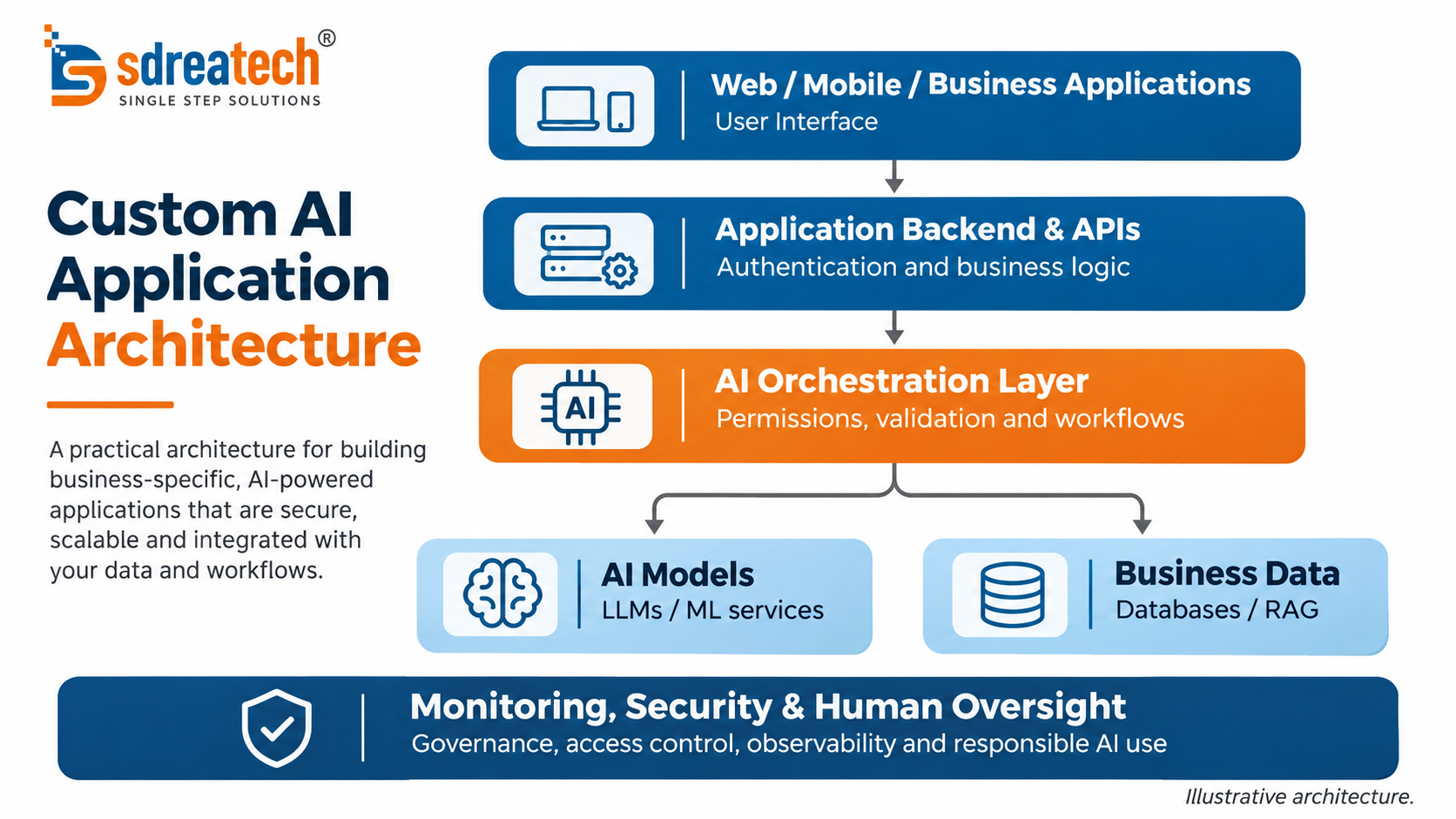
Retrieval-augmented generation allows an application to retrieve relevant information from approved business documents or knowledge repositories before generating a response.
This can improve the relevance of AI-generated answers, although the output still requires appropriate validation.
Fine-tuning an existing model or developing a specialized machine learning model may be suitable for certain requirements. However, these approaches should be selected based on the business problem rather than assumed to be necessary.
The appropriate architecture depends on data sensitivity, accuracy requirements, response times, expected usage and ongoing operating costs.
What a product development team should evaluate before building AI solutions
An important decision in software product development is determining whether a requirement genuinely needs artificial intelligence.
For example, validating a customer reference number against a database does not necessarily require AI. Conventional software logic may be faster, more predictable and less expensive.
Interpreting an unstructured document or understanding a complex customer enquiry, on the other hand, may benefit from AI capabilities.
From a product delivery perspective, the evaluation should cover five areas.
Business feasibility
Does the proposed solution address a measurable business problem? Which existing process is expected to improve, and who benefits from the improvement?
Technical feasibility
Can the existing software architecture, infrastructure and available data support the proposed functionality?
Operational reliability
How will the application handle incorrect responses, unavailable services, unexpected inputs and situations requiring human intervention?
Scalability
Can the proposed architecture accommodate increasing numbers of users, documents, requests and business transactions?
Cost efficiency
Does the expected business value justify the development investment, infrastructure costs and ongoing AI model usage?
Working with an experienced software development team can help businesses evaluate these requirements and establish a realistic implementation roadmap before committing to development.
How to measure the success of a custom AI project
AI projects should have measurable objectives established before development begins.
Depending on the business use case, relevant performance indicators may include:
|
Business objective |
Potential performance indicators |
|
Document processing |
Average processing time, extraction accuracy and manual correction rate |
|
Customer service |
Resolution time, escalation rate and customer satisfaction |
|
Workflow automation |
Manual processing hours, completion rate and exception handling |
|
Knowledge management |
Answer accuracy, information retrieval time and employee adoption |
|
AI-powered products |
Feature adoption, user retention, response quality and operating cost |
A useful evaluation compares these indicators against the performance of the existing process.
For example, if a document processing workflow currently takes 15 minutes per application, the business can measure whether an AI-assisted workflow reduces processing time without compromising accuracy.
This is a more meaningful measure of success than simply tracking how many AI requests the application processes.
Security, reliability and human oversight
When artificial intelligence becomes part of business-critical software, security and reliability requirements become increasingly important.
Organizations should establish clear policies covering:
Which business information the AI can access.
Which actions the system is authorized to perform.
How confidential and personal information is protected.
How AI-generated outputs are evaluated.
Which decisions require human approval.
How errors and unexpected responses are recorded.
What happens when an AI service becomes unavailable.
Applications that interact with external documents or user-generated content should also consider risks such as prompt injection and unauthorized access to business information.
The NIST AI Risk Management Framework provides a useful reference for organizations evaluating AI-related risks and governance responsibilities.
A reliable AI application should include a defined fallback process rather than assume that every generated response will be accurate.
How businesses should approach AI development in 2027
A successful implementation does not necessarily start with a large AI transformation programme.
A more manageable approach is to identify one business process, establish its current performance and evaluate where intelligent capabilities could provide measurable improvement.
A typical development roadmap may involve:
Discovery and feasibility assessment: Define the problem, business objectives and technical requirements.
Proof of concept: Test the proposed approach using representative business scenarios.
Minimum viable product: Deliver a focused implementation with essential functionality.
Pilot deployment: Introduce the solution to a controlled group of users.
Evaluation and optimization: Measure results, address limitations and improve reliability.
Production rollout: Expand the implementation once the business and technical requirements have been satisfied.
Each stage should have clearly defined deliverables and acceptance criteria.
This allows businesses to manage investment progressively instead of committing to a large-scale development project before the approach has been validated.
Building AI around business objectives
Artificial intelligence should be considered part of a broader custom software development strategy rather than an isolated technology investment.
The most suitable solution might be an intelligent customer-facing application, an internal automation platform or a business management system that combines traditional software logic with AI capabilities.
At Sdreatech, our AI development services focus on designing software solutions around business requirements, helping organizations evaluate where artificial intelligence can create practical value.
For businesses that already operate established software platforms, our AI integration services offer an alternative to developing an entirely new application.
The decision between custom development and integration should be based on the existing technology environment, business objectives and long-term product roadmap.
Looking ahead to 2027
The next stage of AI adoption will not necessarily favour businesses using the greatest number of AI tools.
It will favour organizations that can identify meaningful applications, establish realistic objectives and implement intelligent capabilities within reliable software systems.
For business leaders, the starting point should be a problem worth solving, a clear understanding of the available information and a practical way to measure improvement.
The technology should follow those decisions.
Frequently Asked Questions
What is custom AI development?
Custom AI development involves designing and building artificial intelligence capabilities around the specific requirements, data, workflows and objectives of a business. It can include intelligent applications, document processing platforms, AI assistants and automated business systems.
How much does custom AI development cost?
The cost depends on application complexity, data availability, integration requirements, AI model selection, infrastructure and security requirements. A discovery and feasibility assessment can help businesses establish an appropriate development budget.
How long does it take to develop a custom AI solution?
Development timelines vary according to the scope and complexity of the project. A focused proof of concept may take a few weeks, while a production-ready enterprise application may require several months, including testing, integration and security validation.
Do businesses need to develop their own AI models?
No. Many businesses can build custom AI-powered applications using existing AI models, approved business data and application-specific logic. Training or fine-tuning a model is only necessary when justified by the requirements.
Can custom AI solutions integrate with existing software?
Yes. AI capabilities can often be integrated with existing CRM, ERP, SaaS, web and mobile applications through APIs, middleware and secure backend services.
What is the difference between custom AI development and AI integration?
Custom AI development focuses on building tailored AI-powered applications or solutions. AI integration focuses on introducing artificial intelligence capabilities into existing software and business systems.
Planning to build an AI-powered product in 2027?
Whether you are exploring intelligent workflow automation, an AI-powered application or a custom enterprise solution, Sdreatech can help you evaluate your requirements and define an implementation roadmap.
Discuss your AI development requirements with our team.